Showing posts with label global. Show all posts

Sunday, January 19, 2014

Fabric Collar - Do It!

Sewing Kantha Fabric Collars with Santina Cessor
Pin It
This week's DIY post was by Santina Cessor, the talent behind the Threads, a blog about sewing and fashion. Santina only started sewing about a year ago, but she was a quick learner and started doing custom alterations on vintage clothes for friends and clients. I asked Santina to take some of the scrap fabric I've been collecting and make us something easy and useful. Keep reading for a step-by-step how-to of how to make a fabric collar. Santina chose to work with one of our vintage kanthas.

DIY Fabric Collar
by Santina Cessor

A simple accessory can update any outfit. You might pile on bracelets, earrings, necklaces or even a scarf, but have you thought about adding collar? Collars, Peter Pan collars in particular,  have been a fun fashion trend we've seen everywhere – high-end runway looks, ready-to-wear-fashion, DIY.

Creating your own collar is simple and can be completed with just a few tools.

Tools

  • Cutting Board
  • Scissors or Rotary Cutter
  • Paper
  • ½ Yard fabric
  • Thread (matching or contrast)
  • Ribbon

Sewing Kantha Fabric Collars with Santina Cessor-3

1. Create your collar pattern on paper similar to the one above. Be sure to measure your neck to confirm the curve is large enough. Click here for a free printable pattern by Sewing Like Mad.

2. Fold fabric in half and place pattern atop it along the fold. Then pin in place.

3. Carefully cut fabric along the pattern. Repeat step 2 & 3. You should end up with two pieces.

Sewing Kantha Fabric Collars with Santina Cessor-4
4.  Place pieces right side together and pin.

5. Set up your sewing machine for straight stitch, or thread your needle for hand stitching. You’ll need a standard foot and edge foot.

Sewing Kantha Fabric Collars with Santina Cessor-5
Sewing Kantha Fabric Collars with Santina Cessor-6
Sewing Kantha Fabric Collars with Santina Cessor-7
Sewing Kantha Fabric Collars with Santina Cessor-8
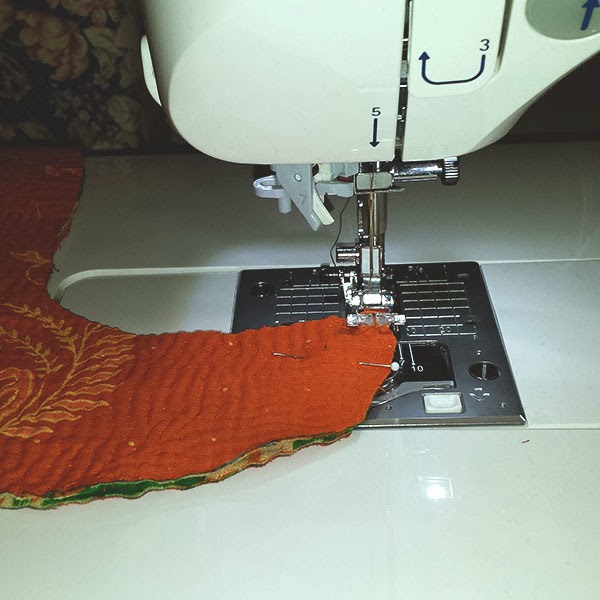
6. Sew along the curves end to end leaving a ¼” seam allowance. When finished turn fabric right side out and iron.

7. On the open end gather ¼” on each side and fold over towards each other, then pin in place. Sew along the edge with edge foot and leave 1”on each end.

8. Push ribbon into 1” opening then fold ¼” seams toward ribbon, pin together. Fold ribbon to the back and stitch together.

Sewing Kantha Fabric Collars with Santina Cessor-9

The nice thing about collars is that you can quickly change your look by switching out the ribbon. Change the color palette and slip in a hot pink or black ribbon. Add some texture by trying lace. Swap in a luxurious silk ribbon. Or pin it demurely with a jeweled brooch. The collar offers many, many different looks that can change just about any outfit.

Have fun trying out this new look and we'd love to see what YOU come up with. Also, in case you missed it, see our gift bag DIY with #fabricscraps right here.

Thursday, October 31, 2013

Working With Designers

Sanctuary Interior Design Build
I work with numerous designers through the The Loaded Trunk and often get to see the results of their projects. Blankets are re-imagined and re-upholstered into dining chairs. Intricately detailed, vintage skirt bottoms are turned into pillows. Everyday textiles become great pieces of art. Everything is flexible and interchangeable with a designer's vision.

Millar Key West took a bunch of our frazadas and covered dining room chairs for one of their clients. Each chair was slightly different and together, they created a stunning and colorful visual. You can see the chairs in the dining room above. 


Mud cloth is another textile that I often see covering furniture. Geometrics are still trending hot in all areas of design from interiors to fashion to textiles. Mud cloth, especially, is so versatile. While its pattern is detailed and exciting, the neutral, black and cream coloring make it an easy addition to home decor. Below are examples that I've found on Pinterest and various designer blogs. Read about the history of bòlòganfini here and see our entire collection here.
Large Bòlòganfini from The Loaded Trunk
via Design Sponge
HotMoonCollection.com via Pinterest

While I was traveling in Morocco, I had these vintage patchwork kilim rugs made especially for The Loaded Trunk. In its third (and possibly later) iteration, these scraps of patchwork turned this fairly traditional arm chair on its head. Isn't it amazing what a bit of reupholstery can do for furnishings? You can see the entire collection of patchwork kilim rugs here.
Patchwork Kilim Rug by The Loaded Trunk
Pin It

In addition to all the great designer work I come across, many of my customers send pictures of how you've styled or re-interpreted items from The Loaded Trunk into your homes. I love to see your creativity in styling global home decor in your living spaces. It's anything you can imagine it to be!

Wednesday, August 21, 2013

A Closer Look at Bògòlanfini (Mud Cloth)

Pin It
Bògòlanfini, popularly known as mud cloth, is made by the Bamana people of southwestern Mali. The Bamana are a village based society mainly consisting of farmers, though textile artists are one of many “craft castes” that one is born into. Cotton cloth woven into strips by men is decorated in symbolic geometric patterns by women by a several-stage discharge method using mud, bark and vegetable dyes. 


Bògòlanfini created international interest when it was introduced into the fashion design world in the early 1980s by young Malian designer Chris Seydou. Artists continue to update the tradition today, introducing more colors and larger, bolder designs for the local and international market.


I've kept some of the mud cloth as pure textiles, but have turned some into feather-filled pillows. See the entire bògòlanfini collection here.


Tuesday, July 9, 2013

To Four and Many More

 
Pin It


When I started my business four years ago, I didn't know where I would be today or even if I'd still be in business. But against all odds and two recessions, I am still hanging on, and I'm very proud to say I haven't changed my original concept of being global, ethical, ecletic and timeless. 

I have you, my wonderful customers, to thank for enabling my addiction to travel, joining me on my adventures in cultural immersion and making it possible to continue working with artisans all over the world. You inspire me with your living spaces, how you mix styles and fusing the old with the new.


As a special thank you to my readers, buyers, fellow textile junkies and collectors, I'm giving away four special items from The Loaded Trunk, one for every amazing year.

Here is to year 4! See below for details on how to enter and win. 

1. I have four separate contests for each different social media platforms. I realize not everyone has the time to join everything so I'm spreading the love. Just follow the directions below and message me if you have any questions.

2. Win extra chances by following the blog and leaving a comment in this post.

3. Contest runs the entire month of July. Winners will be announced on or before August 9th. Good luck!


Sign up for our email list here and win one of these lovely Thai Ceramic Vessels.


Like The Loaded Trunk on Facebook and take your pick of one of these Silk Ikat Scarves.
I'll post this contest to our facebook page. You just have to leave a comment
and tell me which scarf you like best.

Pin It

Along with so many others, I love Pinterest for keeping me inspired.
Pin this image and follow The Loaded Trunk here for your chance
to win this sweet Baby Kantha blanket and pillow .

I'm still feeling my way around twitter, but I'd love for you to join in on the conversation.
Follow me on twitter, tweet me your best travel trip and don't forget to hashtag it with #giveaway.
The winner will get their pick of one of these large alligator or crocodile staplers.

Tuesday, June 11, 2013

A Closer Look at Kuba Cloth


Pin It

Kuba applique cloth is a traditional royal textile from the Kuba kingdom of the east central Democratic Republic of Congo. Since the founding of the empire by the Bushoong people in the early 1600s, each new king would be responsible for introducing new patterns that were invented by, and named after designers, and was an honored achievement. Hundreds of royal patterns are known today and are collaboratively made.

Men weave raffia fiber on a loom and women applique cut shapes of raffia textile, tie-dye, or embroider fibers that are cut to create a cut-pile, velvety surface. The abstract shapes, arranged in bold designs, appear to be in a regular pattern, but actually embrace an asymmetrical composition. Similar patterns can be found on woven panels used in architecture, woven mats, and even carved wood objects such as court containers and masks. The British Museum has a wonderful example of a partially woven cloth pre-applique on a loom which you can see here.


The cloth was once only worn by members of the royal court for ceremonial events and would have been wrapped several times around the waist as a skirt, making the wearer appear larger than life as well as publicly announcing their status. Textiles are kept in the family treasury, used in gift giving, and presented at funerals for important members of the kingdom, and were traditionally used as currency.

Today, Kuba textiles are produced for local use, exported, sold to art collectors, and is heralded as one of the great international abstract art forms. To learn more about Kuba cloth and its history, check out the collection by The Metropolitan Museum of Art here. The Met shows various forms of the artwork, exhibitions and an art history timeline.
We have only one Kuba cloth in its original form as a textile in the shop. The others have been made into magnificent feather-filled pillows as you can see below. Click through to see the entire collection.


Sunday, May 26, 2013

Teak Panel With Protection


Pin It

When I go hunting for global treasures in Thailand, it's imperative that I go to the trusted craft and trades people who I have become close to and work with during every trip. Like many businesses, it's about relationships. Working with people you trust and you know respect and understand what is important to me when I make purchases. I like to buy local, fair-trade, and from people with a conscience. This can be tough to figure out when you are alone.


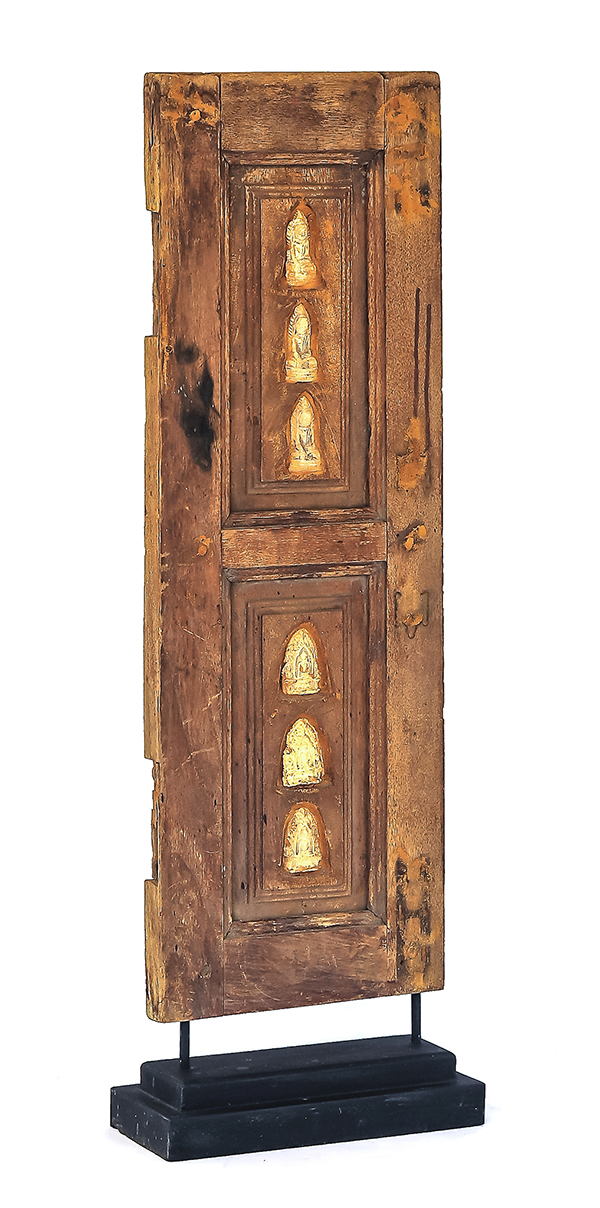
This Amulet Panel comes from the happiest guy I know in Chiang Mai. He is a hoarder, a collector and innovator. When I am in his work space, I begin by putting a pile together. It can takes hours. This is just one of the pieces I scooped up on my last trip. 


This particular panel is made from an old, teak window panel and adorned with Buddhist amulets. It measures 10.5-inches wide by 31-inches high and is about 4-inches deep. Mounted on a black stand, it will surely offer major protection and is an art object for any space. 


Amulets are serious business in Thailand! If you want to know more about them in general,
here is a link to some interesting information I found...