
Showing posts with label art. Show all posts
Showing posts with label art. Show all posts
Wednesday, April 23, 2014


Friday, January 31, 2014
A Collection of Altars


This year's Lunar New Year celebrations and articles reminded me of the of altars and offering bowls I have in the shop. A relatively small collection, these finely-crafted altars have wonderfully detailed carvings and gorgeous patinas and textures. It gives us a glimpse to where these treasured objects have traveled. Each one worn away differently by age and time, they are now all truly one-of-a-kind.
The rarest altar and one of my absolute favorites is the Buddhist Shrine shown above. Almost all Buddhist homes in Burma contain a hpaya-zin, a small shrine placed on the eastern wall of the house. These shrines house an image of the Buddha where members of the household perform their daily devotions. Made of thickly lacquered and gilded wood, this shrine contains a tooled reflective tin interior with “jewels” which are pieces of cut glass. I have two shrines, one which went directly into my personal collection. The other shrine will be available through The Loaded Trunk soon (if you sign up for our email list, I'll let you know when that happens!).

The form of these brass Burmese Ceremonial Bowls follows that of monks' alms begging bowls. The interiors have beautiful patinas that have developed over the last 75 to 150 years. Relief work is hand chased and detailed with scenes from Burmese folklore. It seems likely that these bowls were made to be used on an altar before an image of Buddha. They were meant to hold water and thus flowers and would have stood to either side of the image.


This Buddhist Spirit House is another work of art that that is a unique "only one." A representation of a home or temple, spirit houses are typically found in Laos, Cambodia, Thailand and Burma. They are placed in auspicious places in the home and provide shelter to spirits who need to appeased with offerings. I love the symmetry and detailed carvings, a statement piece with so much architectural interest. This currently isn't available in the shop, but please email me if you're interested in more details and pricing.
 |
| Sorry, this piece has been sold. No longer available. |
Finally, these stone architectural artifacts, recycled from old buildings, were salvaged from the ruins of old houses in India. No two are alike. They are weighty, rustic and fantastic. Lean them in a favorite corner of a book shelf or place one in your garden. Quite large, they're sculptural and unique; their inset nooks make an ideal spot to create an devotional altar of your own. The piece shown above with the blues, greens, and stone and rust tones is no longer available. See the other three right here.

Friday, September 6, 2013
Get That Art Up

One of the drawbacks to getting affordable, unframed prints is figuring out to display them. Professional framing can cost an arm and a leg, especially if you have a large piece. That's when you see beautiful pieces collecting dust and often times, stored away and then forgotten. But don't let a little framing challenge stop you. If you think creatively, there are lots of way to display art. This week I'm sharing just how to do that featuring some high-quality reproductions from The Loaded Trunk that are collectible, unique and best of all, affordable.
/1/ Wood Pant Hanger
Wood pant hangers hold the top edges of the print flat without damaging it. Either hang directly onto a simple nail or tie a ribbon or some fishing line to the hanger and secure to the molding on your ceiling. They can easily be found on-line or in your local antique store.
Etsy is a good place to find vintage hangers on-line, but don't forget to check your local antique store as well. » Set of 9 Vintage Pant Hangers, Etsy
/2/ Simple Black Frames
Most of these prints employ black as a major color element, either dominating the piece or defining certain parts of the design. Black frames pull the color out and when grouped, create a cohesive collection. » Set of 4 Gallery Style Frames, West Elm
/3/ Vintage (or New) Wood Clothes Pins
Tie invisible fishing line to wood clothes pins. Clip them on to your print, add a couple of nails and voila, your print is up on the wall. Vintage ones are especially nice because they have such a great patina. » Set of 10 Vintage Clothes Pins, Etsy
/4/ Rustic Wood Frames
Even though these posters have a very modern, graphic quality, rustic wood frames add an element of warmth to the pieces. Don't be afraid to trim the posters slightly.
» Rustic Barnwood Frame, Etsy // » Shutter Frame, World Market
» Rustic Barnwood Frame, Etsy // » Shutter Frame, World Market
The role of the poster has been historically connected with nationalistic struggle and plays an important role in provoking political action. Our collection of Vietnam War era propaganda posters continue their role as provocative conversation pieces in addition to be graphically stunning. The Loaded Trunk's Vietnamese Propaganda Prints are printed on rice paper and measure approximately 12" x 15" unframed. $39 each. Click here to see entire collection.
Monday, August 12, 2013
Loaded Trunk Art Tour


Recently, I invited art historian and art history professor Deborah Dickson to my home. Deborah specializes in African art and teaches at several colleges and universities in Kansas City including the Kansas City Art Institute and Rockhurst University. She looked at my pieces and we talked about travel, the local art scene, textiles as an art form, especially Kuba cloth, and just a bit about how I grew up. Below are her thoughts about my collection. Enjoy the tour!
------------------------------------------------------------

Walking up to Roni’s Westside Kansas City second floor condo is like the appetizer before dinner, where you are introduced to an array of colorful textiles and sculptures from around the world. Her contemporary living space, with a stunning view of the downtown skyline, serves as a backdrop for her international collection of arts and crafts.


As Roni introduces her private collection, it is clear she has a passion for the quality and beauty of the objects she gleans on her trips to Morocco, Thailand, India, Turkey, and other countries. Though the majority of her finds make their way onto the Loaded Trunk eye candy menu, she finds many pieces that she wants to live with.


Though the majority of her collection is related to the traditional ritual arts of Asia and Africa, these are interspersed with contemporary art. A favorite local artist, Mark Westervelt, is represented by several large paintings and small works that complement Roni’s diverse taste in their varied subjects and styles.
Other contemporary works are made by international artists, such as the expressive portraits by Hanoi artist La Ba Quan. Though many designers try to match art to the furniture, Roni prefers to let the art take the spotlight, and let her modern, stylish furnishings function as pedestals, or places to sit and contemplate, the gorgeous art (which, admittedly, distracts the visitor from the great view out the large windows).


All my art has a story and a memory attached, much like all of your art and collectibles. Thank you Deborah for the walk down memory lane! And thank you for joining us.
Tuesday, June 11, 2013
A Closer Look at Kuba Cloth

Kuba applique cloth is a traditional royal textile from the Kuba kingdom of the east central Democratic Republic of Congo. Since the founding of the empire by the Bushoong people in the early 1600s, each new king would be responsible for introducing new patterns that were invented by, and named after designers, and was an honored achievement. Hundreds of royal patterns are known today and are collaboratively made.
Men weave raffia fiber on a loom and women applique cut shapes of raffia textile, tie-dye, or embroider fibers that are cut to create a cut-pile, velvety surface. The abstract shapes, arranged in bold designs, appear to be in a regular pattern, but actually embrace an asymmetrical composition. Similar patterns can be found on woven panels used in architecture, woven mats, and even carved wood objects such as court containers and masks. The British Museum has a wonderful example of a partially woven cloth pre-applique on a loom which you can see here.

Today, Kuba textiles are produced for local use, exported, sold to art collectors, and is heralded as one of the great international abstract art forms. To learn more about Kuba cloth and its history, check out the collection by The Metropolitan Museum of Art here. The Met shows various forms of the artwork, exhibitions and an art history timeline.
We have only one Kuba cloth in its original form as a textile in the shop. The others have been made into magnificent feather-filled pillows as you can see below. Click through to see the entire collection.

Sunday, May 26, 2013
Teak Panel With Protection


When I go hunting for global treasures in Thailand, it's imperative that I go to the trusted craft and trades people who I have become close to and work with during every trip. Like many businesses, it's about relationships. Working with people you trust and you know respect and understand what is important to me when I make purchases. I like to buy local, fair-trade, and from people with a conscience. This can be tough to figure out when you are alone.

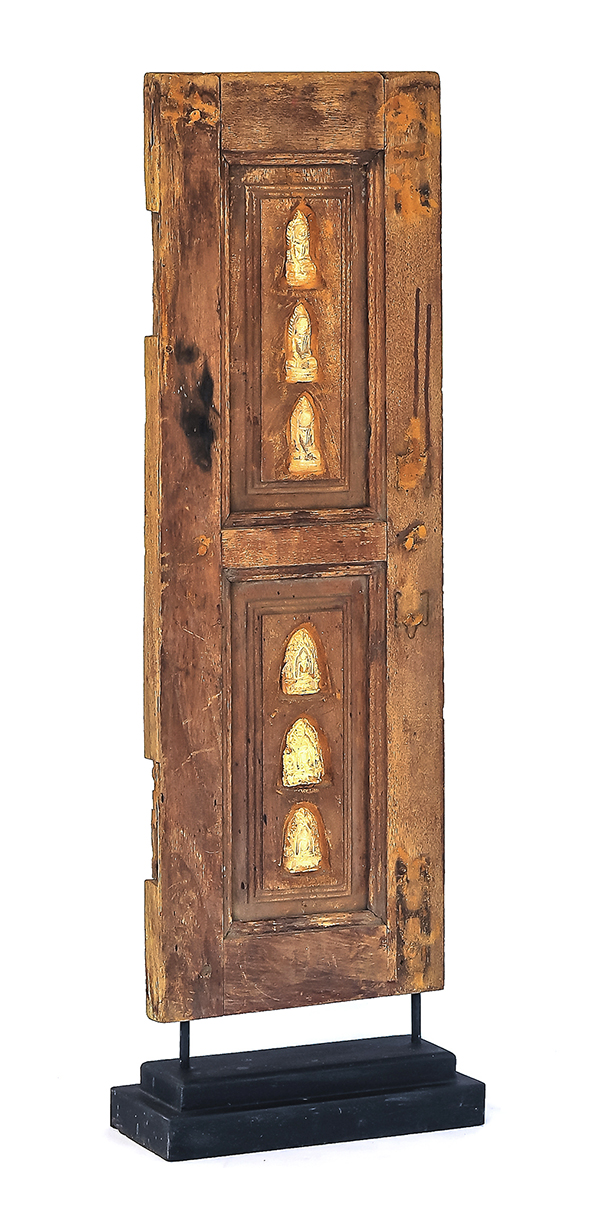
This particular panel is made from an old, teak window panel and adorned with Buddhist amulets. It measures 10.5-inches wide by 31-inches high and is about 4-inches deep. Mounted on a black stand, it will surely offer major protection and is an art object for any space.

Amulets are serious business in Thailand! If you want to know more about them in general,
here is a link to some interesting information I found...
Subscribe to:
Posts
(
Atom
)